
In recent years, Europe has been facing increasing strategic challenges. Between the hammer of concern and fear of Russian expansion in the east, and the anvil of repeated American threats to withdraw from NATO, and the American threats regarding the seizure of Greenland, Europe found itself facing increasing strategic challenges that raise questions about its security and international role. It is a continent heavily dependent for its security on a volatile ally like America, which brought Trump for two presidential terms in ten years, Trump who did not hide his anger at the coldness of European leaders towards his recent war against Iran and their refusal to engage in his war despite NATO announcing that it had supported America in this war to the extent possible, after a stormy session with Trump during which they received much reproach.
This American pressure, combined with a belated European awareness of the need for self-reliance, led to a noticeable increase in armament budgets and defense spending, with EU countries' defense spending amounting to around 381 billion euros in 2025, while it was about 251 billion euros before the Russian-Ukrainian war in 2021. Moreover, Trump's pressure on NATO countries led them to acknowledge the necessity of allocating five percent of the gross national income for armament and defense spending, which equals approximately a trillion euros.
This context raises questions about funding sources and defense spending priorities amid an increasing demographic crisis.
The Rising Right: "National Necessity" in Times of War
As concerns over Europe's fate and economic crises and the large number of immigrants increase, the features of the rise of the far-right have begun to appear in Europe. It is no longer just a populist wave but has gained increasing political presence in Europe, with some European countries witnessing a notable rise of right-wing currents.
War—as an idea and a practice—requires a nationalist charge, armies that believe in the purity of the cause, and nations ready to sacrifice comfort for their national security, which may ease the passage of more sensitive austerity or security policies in some contexts such as certain human rights and issues concerning migrants without severe internal opposition.
While the liberal left, talking about pluralism and migrants' rights, has, in the eyes of some decision-making circles or political elites in Europe, become an obstacle to transitioning to a "war economy"—Europe is not trying to reach this type of economy but is trying at the same time to stay close to it in case circumstances change in Eastern Europe.
The idea returned that the right is the only tool capable of justifying the deduction of health and education budgets in favor of arms and is the most capable of identifying and defining the internal enemy in a framework far from liberal romanticism.
The war may not seem imminent, but preparing and equipping the population takes time, as war factories need time to achieve the result Europe desires in terms of weapon readiness.
Even some countries that have not moved toward the right have sometimes been forced, due to the significant convergence in election results, to implement some right-wing agendas, especially on immigration and political Islam, as is the case in the Netherlands.
The Great Paradox: The Need for Migrants Versus Suspicion of Them
Europe, the old continent whose people have refrained from caring about population issues, has in recent years gone to affirm the name of the old continent with all its meanings. Since the major refugee wave in 2015, European facilities have experienced increasing pressure in some countries, from hospitals, factories, and logistics services, with the influx of foreign labor, and a large part of this labor comes from Muslim backgrounds—certainly, there are other sects and religions, but the European concern about Islam is what concerns us here.
While the migrant was "the lifeblood" filling the gap of weak European population growth, immigration laws since 2022—after the beginning of the Russian-Ukrainian war—started to take a radically stringent turn.
Herein lies the paradox. Europe, which needs the migrant body to manage its facilities, shows in some political discourses increasing concerns about the religious identity of this migrant. With the rising tone of Islamophobia in official political discourse, discrimination is no longer just an individual behavior, but has turned into a "filtering" strategy aimed at identifying who is fit to be "part of the fabric" and who remains "an outsider under scrutiny".
Additionally, the forced increase in immigrant numbers, particularly refugees in Europe, and the legal loopholes that many of them exploited, such as unemployment and integration programs, have cost Europe billions of euros and still do, while the benefits it derives from this immigrant group do not approach the value spent on them, with security costs remaining the biggest concern for Europe.
The "Brotherhood" Scapegoat and Cross-border Interests
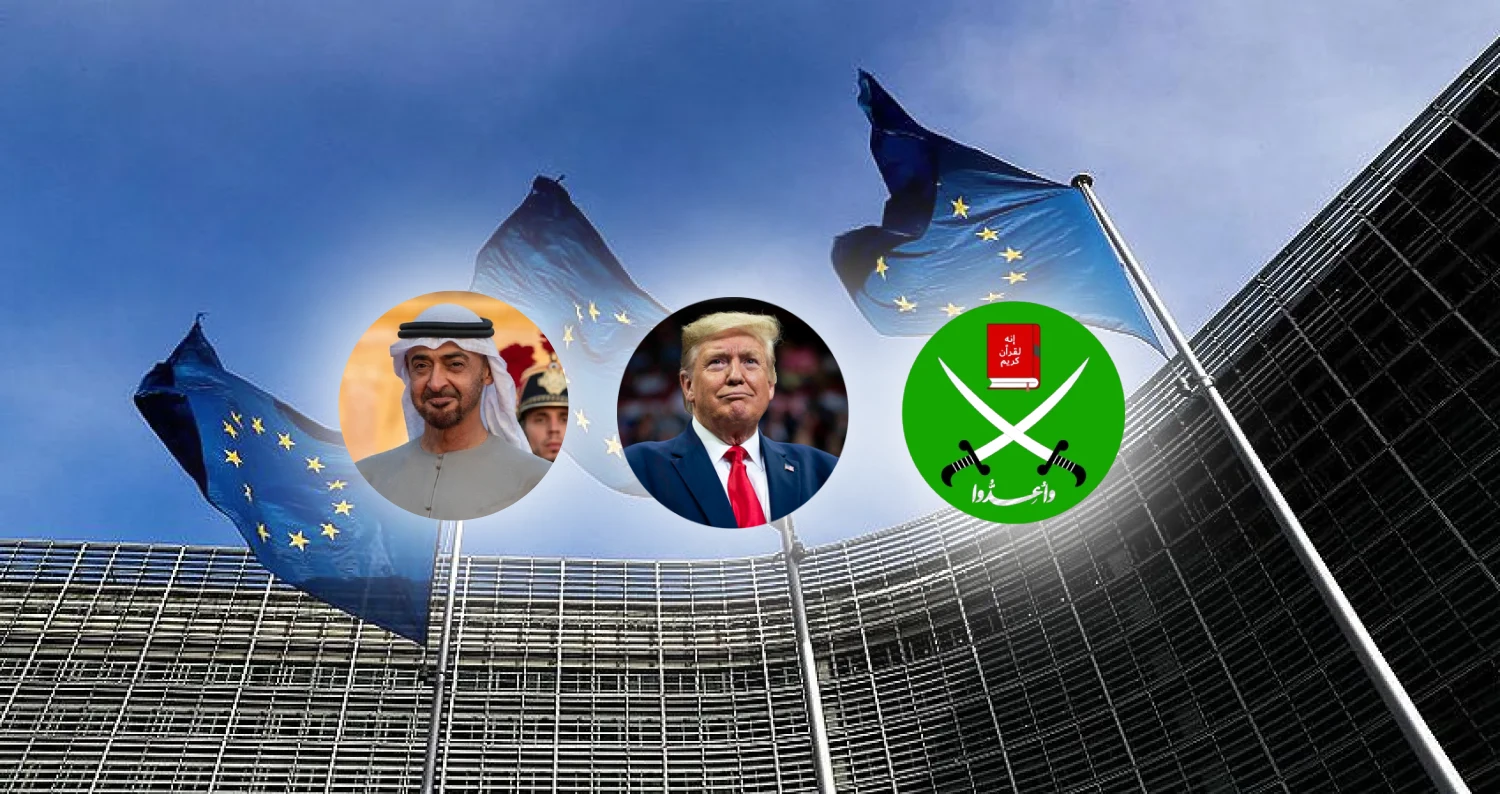
To understand the recent European orientation to ban the "Muslim Brotherhood" or classify it as terrorist—as happened in the Netherlands and other countries—we must not overlook the regional role of the Gulf countries, specifically the UAE and then Saudi Arabia.
After the Arab Spring, and after it became certain to the rulers of those countries that the presence of Islamists threatened their thrones and kingdoms, after they won most of the elections that took place in the countries where the Arab Spring revolutions succeeded and pushed Western capitals to besiege them, those countries began to exert their utmost efforts, along with other countries like Egypt, to demonize Islamists, especially the political current among them, and convince the whole world of the necessity of getting rid of them.
Through the language of interests and investments—which Europe understands and needs at this critical juncture to fund the faltering economy and defense spending—it seems that Europe has accepted the barter; so some European countries began to re-evaluate some groups previously classified within the political or advocacy domain. Indeed, often they were classified as "democratic partners". The matter even reached a point where a country like the Netherlands—which used to describe what happened in Egypt in 2013 as a coup—has adopted today the same narrative, and seeks, if the step is taken, to tighten on the Islamic presence under the banner of "combating extremism".
This trend was escalated by the events that began on the seventh of October 2023, and the ensuing brutal war participated in by America, Israel, and the Gulf against Iran, Hezbollah in Lebanon, and Hamas in Gaza.
Despite the Muslim Brotherhood being the least radical and least violent Islamic organization, they were targeted by the classification, while, in contrast, Europe that classifies them was the one that supported and accommodated Ahmad Al-Shar’ah, the former Syrian jihadist leader and former leader of Al-Qaeda in Syria, for several years, and acknowledged his presidency of Syria after the fall of Bashar.
This paradox opens a discussion about the multiple dimensions affecting these policies and whether these policies have other dimensions besides combating extremism. Is it possible to view one of these dimensions in the context of the relationship between some of these groups and the Palestinian-Israeli issue—if we consider Hamas as part of the Brotherhood—including their easy access to power through genuine popular elections, unlike jihadist factions that are shunned by the populace, and an attempt to place the Brotherhood alongside jihadist groups in global public awareness?
Questions for an Anxious Future:
Amid this complex scene and escalating measures, there are questions that need to be faced:
Can the classification of the Brotherhood be considered a final goal or part of a broader security approach that allows the nation-state to delve into the minute details of Islamic presence (mosques, schools, funds) to reshape it to align with national security necessities?
In light of the move to increase military spending and the need for absolute loyalty in times of crisis, how will Europe deal with a large human bloc that believes the state does not trust its loyalty?
How does the Muslim migrant interact with ongoing political and security transformations?
Europe is today witnessing a reconfiguration of some of its internal policies before the external ones amid the intertwining of security, immigration, and foreign policy issues, and the question remains not only about what governments are doing but about the ability of migrants and Islamic currents to understand these transformations."
This is an AI-generated English translation. The original text is in العربية