
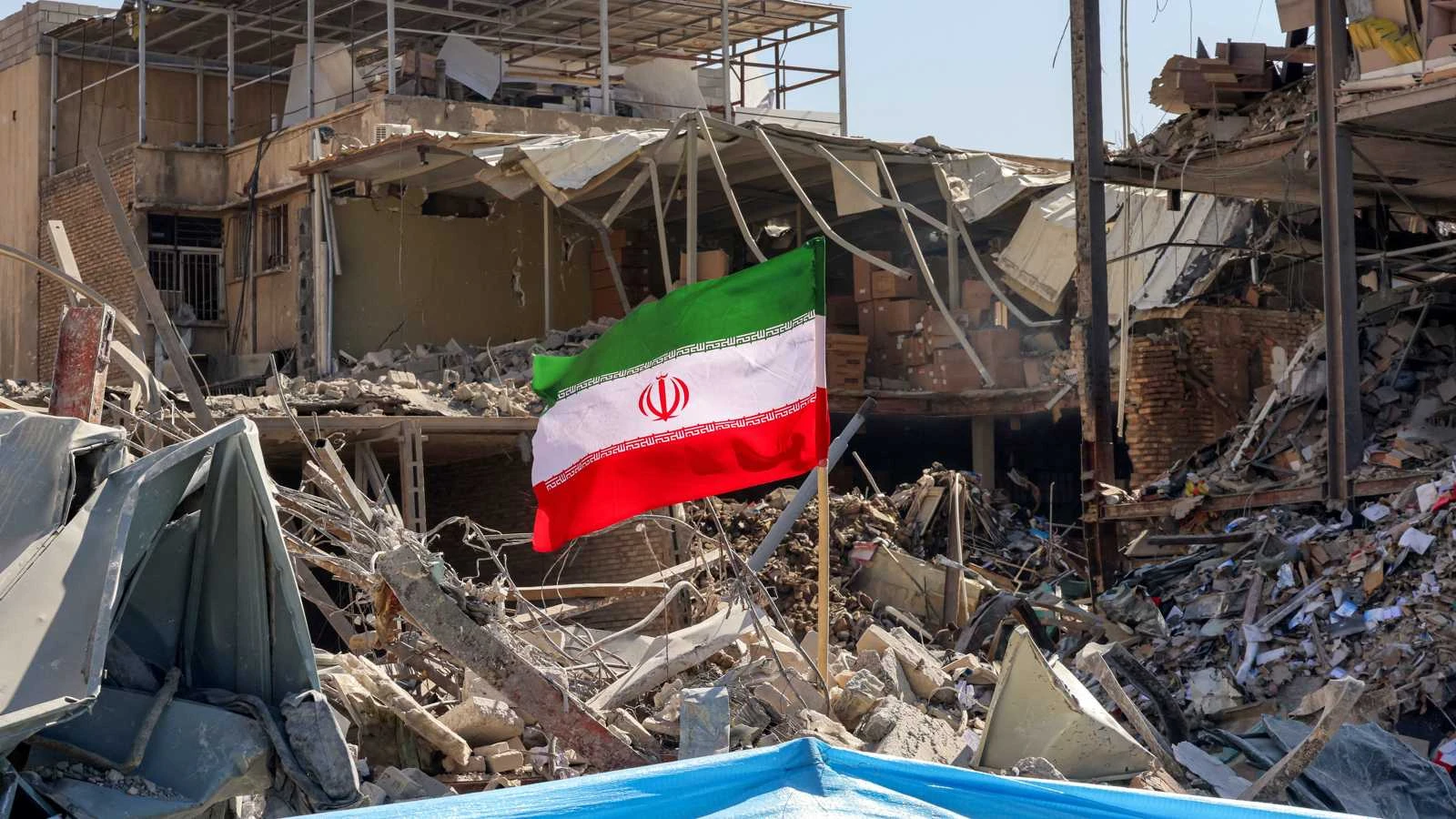
The truce announced by President Trump for two weeks, which came into effect on April 8, 2026, did not serve as a clear conclusion to the war but rather as an ambiguous pause that raised more questions than it answered.
While the White House portrays what happened as a strategic victory, the Iranians offer a parallel narrative based on resilience and non-surrender. Between the two narratives, a gray area forms where it is difficult to distinguish between what was actually achieved and what is politically and media-wise being repackaged.
This ambiguity increases with the absence of official details of the truce terms, making any decisive interpretation risky and placing analysis in front of a fundamental dilemma: How can we understand what happened amid incomplete information and conflicting noise?
In this context, the Strait of Hormuz emerges as a central propaganda headline. While Trump boasts of "opening the strait," the question remains:
- Was the strait originally the goal of the war?
- Or did it later turn into a measure of victory after more sensitive objectives, such as the uranium issue or changing the Iranian regime, stumbled?
The answer, most likely, will not become clear now, but during the next fourteen days, which may reveal whether this truce is a temporary end to the war... or the beginning of a different phase of it.
The Intelligence Truce: Is it a Time Out or a "Sweep" Trap?
In the military dimension, the truce appears as a strategic ploy aimed at bringing out the new Iranian leadership from their bunkers under the guise of calming. As was customary in previous strikes before this war, the Iranians fell into this trap several times, losing most of their leaders under the cover of a truce or cessation of war.
So can we say that Trump is luring the Iranian regime once again to reveal its leadership, hidden platforms, and counter-plans prepared during the height of escalation, to then process this data intelligence-wise, militarily, and security-wise?
Given Trump's skill in making deals through maximum pressure to achieve the minimum, his recent threats — to return Iran to the Stone Age — can be read as a means to push Iran to move in two parallel paths:
- A negotiation path to avoid disaster.
- A power path to prepare for it.
Both paths naturally reveal the Iranian regime's plans in dealing with the crisis. Then Trump's retraction from implementing his promises gives him the opportunity to analyze these newly discovered plans, process them, and prepare to avoid them in case he is forced to carry out his threat again, thus gaining favor with the Gulf again, considering they are most exposed to the repercussions of Iranian strikes.
But here emerges a new question: Is Trump planning to resume the war again at a time that suits him with a new blind preemptive strike, relying on an updated target bank during the days of silence? Or will Tehran realize this trap and resort to maneuvering and offering new survival concessions to absorb the American momentum? Noting that Iran has already made many survival concessions in previous phases of this war, but according to Trump and Israel, they were not enough to prevent the return to the military option, where Trump and Netanyahu target the issues of ballistic missiles, enriched uranium, and Iran's support for Shiite militias in the region.
Elimination of Distractions: Were "the arms" left to face their fate alone?
On the regional level, this truce will reopen a new question regarding the fate of "Iran's arms" in the region. While Israel thought it had eliminated the Hezbollah threat in southern Lebanon after the last war, the party surprised Israel by reappearing in the south during the recent Iranian war with notable military presence, prompting one of the Israeli government leaders to say that Israel was overly optimistic about neutralizing it.
Meanwhile, while the Yemeni (Houthi) arm's participation was weak this time and adhered to the American agreement, the Iraqi factions allied with Iran intervened strongly during this war and attacked sites they described as American deployments. With the expectation that Tehran will retreat to its wounds for reconstruction and absorb the shock of its leaders' deaths, we will be facing a more complex question:
- Will Washington and Tel Aviv exploit this retreat to eliminate "distractions" (Hezbollah and the Iraqi factions) once and for all?
- To what extent will the Gulf states stand idly by, seeing an opportunity to secure the Vision 2030 route by eliminating these militias?
- And will Iran sacrifice its proxies to protect the head in Tehran? Even if it doesn't sacrifice them, will it be able to support them under its current conditions?
All these questions arise amid conflicting statements about whether the current truce includes Lebanon, especially Hezbollah, while Israel insists Lebanon is not included and has already started some strikes and threats to villages in the south after the truce.
Trump's Calculations: Midterms, Economy, World Cup:
This truce cannot be separated from the pressures of timing. With the World Cup 2026 approaching in America, the midterm elections, and the fear of the economic repercussions from the closure of the Strait of Hormuz that could give Democrats an opportunity to exploit electorally in the upcoming midterm elections, the question arises:
- Did Trump retract from implementing his promises because they would cost him his political fate with his voters?
- Or did Trump take a step back to impose a new conflict equation?
- And was the truce evidence of the American army leaders' refusal to engage in a long attrition war?
- Or is he using the truce as a "soft" alternative to pressure, instead of the "Stone Age" threat that may have already served its purpose?
And in the event of continued stumbling in the uranium file and ballistic missiles, will Trump resort to "fleeing forward," by opening other files such as the rebuilding of Gaza, to improve his image and divert attention from an incomplete victory in Iran?
The possibility remains that Trump is seeking to buy time to improve economic indicators after reopening the Strait of Hormuz again, before reopening the military escalation option once things stabilize for him in the midterm elections.
The Exhausted Iran
The open skies over Iran and the intelligence confusion in Tehran raise a question about the future of the regime from within: Will internal agents and pressures succeed in overthrowing what missiles and planes failed to do? Or will the regime emerge from this crisis more ferocious and more eager for revenge once the two weeks are over?
The Gulf and Alliances: Has the Era of Betting on External Protection Ended?
Finally, the ongoing war and truce put the region's relationships in a scale of doubt. Have the Gulf states realized, after the strikes they suffered, that American bases are not an absolute shield? And how will the relationship with Cairo be reshaped, considering some parties feel "let down" by Egypt's neutral stance?
In Conclusion
In the end, the current truce does not appear to be a settlement as much as a rearrangement of the conflict equation. It has not settled the big questions; neither about the nuclear program's fate, nor about the structure of the Iranian regime, nor in the issue of supporting Shiite militias in the region. It also raises a question about whether it actually brought Netanyahu closer to achieving his goals for a new Middle East.
On the contrary, it has opened the door to a deeper layer of complexity, where conflict may shift from direct confrontation to less clear areas, more reliant on intelligence, influence management, and dismantling opponents in stages. While Washington is betting on the results of the post-truce, Tehran is betting on absorbing the shock and repositioning. As for the region, it seems to be entering a new test phase that may redraw its balances, or deepen its fragility and reconsider its alliances.
In the end, the truce might just be a short break in an unresolved war... or perhaps a moment of transition from a noisy war to a quieter — and more dangerous — conflict, or maybe to a longer negotiating path than it seems now.
This is an AI-generated English translation. The original text is in العربية