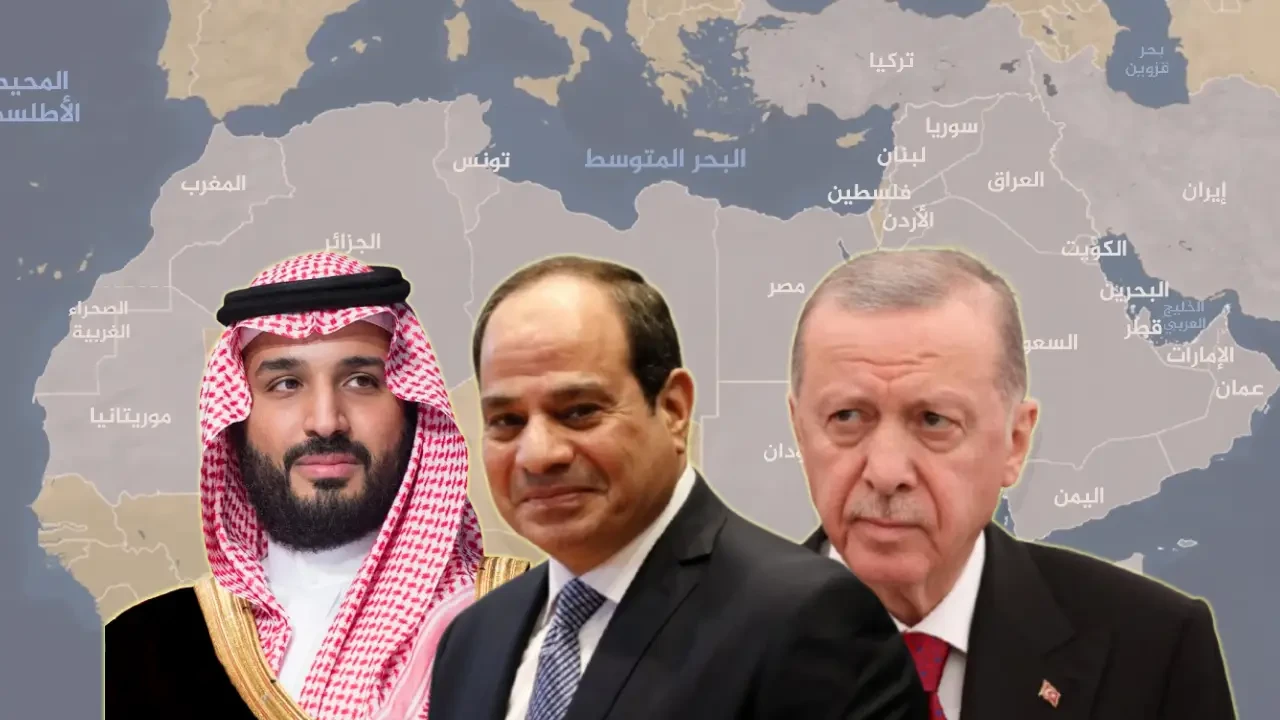
I read an article by one of the political writers about the Turkish-Egyptian-Saudi alliance and its relation to Lebanon and Syria, and although I agree with most of what was written in this article, I see the scene from another perspective that might provide a different or complementary reading, more accurately of the regional scene in 2026. This reading consists of four main axes that we will discuss together in this article, which are:
Despite the noticeable rapprochement in the region between Egypt, Turkey, and Saudi Arabia, we must not overlook the political reality of these countries over the past decade. Since politics is driven by suspicion, this type of rapprochement cannot be as rosy as it appears in meetings and pictures. For example: Cairo still views Turkish expansion in Syria with suspicion and fears and rejects the notion that this influence could transform into permanent occupation from an Egyptian perspective since this would benefit the Turkish influence in the region, which Egypt, the Gulf states, Turkey, and Iran are competing over.
Conversely, Ankara fears fluctuations in the Egyptian or Saudi stances, which have characterized the political reality of the last ten years. Moreover, Egypt is an important ally of Greece, which represents a stumbling block for Turkey in the European side.
Therefore, it seems to me that this uneasy alliance is a marriage of fragile interests that could collapse at the first disagreement over gas shares in the Mediterranean or the division of influence in Damascus or interest convergence with Israel.
Saudi Arabia's Ruthless Pragmatism
Under the rule of Crown Prince Mohammed bin Salman, especially since the end of 2025, Saudi Arabia no longer acts out of nationalism or geographical romanticism, but rather in pure numerical language according to its economic vision for the region (Vision 2030). Thus, if Riyadh finds that its stability requires understanding with Israel away from Turkey and Egypt, it will do so.
Moreover, Saudi financial support is no longer a blank check as it used to be; rather, it is a harsh pressure tool to subject everyone to its economic vision for the region. This might continue to maintain a state of silent tension with Cairo, which does not accept subservience. Looking at the current Saudi financial situation, especially in light of the preparations to host the 2034 World Cup, there is no room for spending outside the state.
The Illusion of Stability in Syria and Lebanon
Next, we come to the assumption that Syria and Lebanon have become sides in the square of Arab-Turkish power, which for me is an incomplete assumption since that idea has not yet matured. However, it is on the path to maturity if the current conditions persist with Egyptian-Saudi intervention in Lebanon to try to reach a solution where Egypt represents the rational side (for the party), and Saudi Arabia represents the economic side and international support (for the government). However, the current reality is that these countries still represent a black hole in the region, as their conditions have not stabilized yet and they still pose a security concern for the surrounding countries, including Egypt.
Thus, the transitional government in Syria, for example, remains weak and fragile, and its power has not been completed yet, while Lebanon is still beholden to sectarian conflicts that geography and topography cannot solve. Additionally, the upcoming parliamentary elections will be a crucial pivot in clarifying the outcomes of the Lebanese situation, and the continuation of the Iranian system in its current form also represents a significant challenge if Iraq is added to it. Therefore, betting on Greater Syria as a support for Egypt in the Fertile Crescent and Nile Valley theory is a hasty bet on a burnt land that has not regained its vitality yet.
The Israeli Player Who Always Disrupts Plans
Israel is also not a mere spectator watching this geographical integration; it actively works through intelligence to undermine this rapprochement from within, even if the Israeli-Iranian conflict seems beneficial to the aforementioned Sunni axis.
Through its intermediaries in the region, Israel continues to play the fear of Iran to extort the square countries. It also uses hot files (such as the Renaissance Dam or support for militias in Sudan, Libya, and Syria) to keep Egypt and Turkey preoccupied with their other borders, which weakens and slows down the practical formation of this alliance.
Conclusion
In reality, it seems that the region is racing against time to reach a potential point of convergence upon which to build, but the changing moods of the political systems in these countries and the approaching elections in some could be a significant reason that reduces the chances of success of this alliance. Moreover, the dominant American power plays a role in determining what is acceptable and unacceptable within this alliance.
The current rapprochement in 2026 is not a national or religious awakening; rather, it is an alliance of the compelled, and I do not say that this alliance was stillborn or destined to fail, but it relies on the continuation of the bad situation in the region as it is (a state of ambiguity and tension), and it bets on the stability of the political mood of the allies (leaders).
Everyone is afraid of everyone, and everyone is allied against a common enemy (Israel or economic collapse), but keeping a dagger behind the back, anticipating any treachery from the ally before the enemy.
This is an AI-generated English translation. The original text is in العربية