

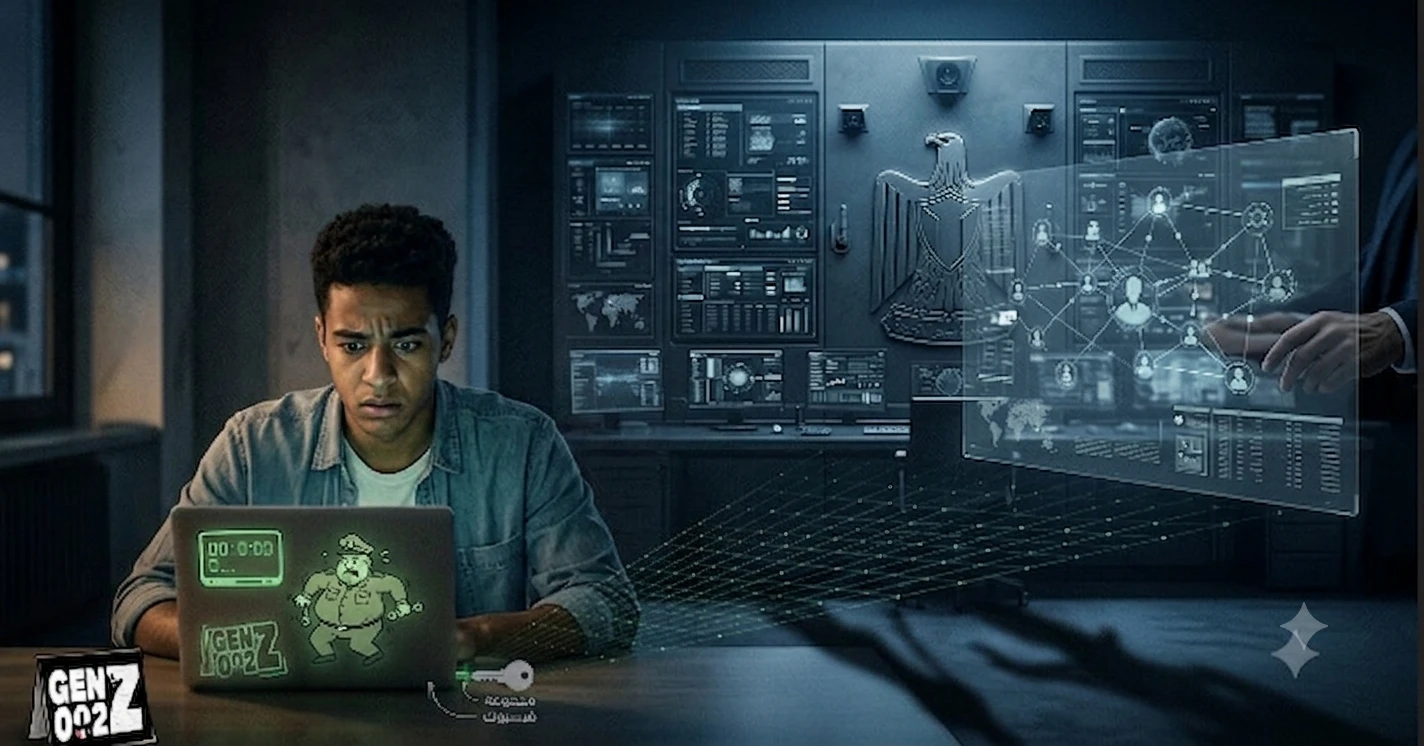
In recent days, details related to investigations with a number of young men and women in the case known in the media as "Generation Z" have emerged. A lawyer interested in the matter and following it pointed out that access to some of the accused in this case was made through seemingly simple digital details, such as not paying attention to privacy settings of groups or followers' lists or even knowing that the lists of those who joined Facebook groups are often available to anyone who enters the group.
What happened may be the result of advanced technical capabilities, either in monitoring and tracking by Egyptian security forces, or may result from human errors exploited in simple traditional ways that ultimately led to what happened.
In my opinion, the main question should not be about how this happened but: why did some assume it was not possible in the first place? Or why did some not consider it? Or did they ignore it despite its seriousness?
Here I want to return to an idea I previously presented, which is summarized by saying that some regimes, especially in the North Africa region, do not always showcase or display their full security and technical capabilities to the public but sometimes deliberately conceal these abilities, trying to maintain an outwardly balanced image that does not necessarily reflect the true level of these regimes’ capabilities.
Strength is not always in what is displayed
In the world of security and intelligence, strength is not always in displaying all you have, but sometimes concealing part of these capabilities is more effective and important than announcing them.
Because an opponent who believes they are dealing with a limited-capability device may act with less caution and vigilance, thus using tools and methods they would not have used if they had a different assessment of the capabilities of the other party.
However, this does not mean that every security success is the result of a complex intelligence plan, nor does it mean that every mistake made by opponents is the result of a pre-set trap. But it means and confirms in my opinion - that the mental image each party has of the other is the most influential element in the ongoing conflict between them.
The "stupid regime" narrative
Here emerges the danger of one of the most widespread narratives in the Egyptian – and indeed Arab - media and political opposing discourse, which is depicting the regime as technically backward, administratively incapable, and unable to understand the tools of the era and keep up with developments.
Criticism of the regime or opposition to it is not the problem we are talking about but is a natural matter in any political conflict where media is used as a means of opposition. But the problem begins when this criticism turns into a fixed conviction that the opponent – the regimes in this case - cannot develop, learn, or use modern tools, and it cannot be excluded that some regimes may benefit from the continuation of this mental image, either by not correcting it or by dealing with it as being less harmful than some believe
This image may give its holders and their followers a general feeling of superiority, but at the same time, it turns into a point of weakness and a serious flaw; because then decisions are not based on a real opponent but on an opponent that exists in the imagination of this opposing group and its supporters.
And then this narrative may turn from a political mobilization tool into a factor that weakens the capability of opposition to actual work.
Underestimating the opponent
It is customary in political and security conflicts that people do not always lose due to a lack of tools and information, but sometimes due to underestimating the other side, even if there is information that helps in correcting the misjudgment but is ignored either naively or disbelievingly.
The opponent may indeed have real weaknesses, may make many mistakes, and may fail in various files. But turning these points into a total image of complete incapacity is a strategic error.
A person who is convinced that their opponent cannot monitor them or understand their digital movements, for example, may reduce their level of caution, and then they may make mistakes that could have been avoided if they had given their opponent enough credit.
Therefore, the question in the electronic groups' issue should not be: how were they able to reach? But why did some assume they would be unable to reach?
The narrative of ignoring or denial does not generally benefit despite it being the followed narrative.
Reading events through a single interpretation
This problem – misjudgment and reading - is not only related to the digital aspect but also appears in the way of reading political, economic, and security events.
For instance, when the issue of the Egyptian plane in Zambia and the related money and gold emerged, segments of the opposing discourse directly went to a single interpretation related to corruption and smuggling and still insist on it and repeat it.
I do not deny that this interpretation may be a proposed and acceptable interpretation with importance and evidence pointing to it, but the problem starts when any event turns into a preconceived outcome and a single interpretation that closes the mind to other theories and parallel ideas.
In managing states, there are always files working in secret away from the public, whether these files are economic, security-related, or even related to the file of international relations and there are events carried out by these states that appear on the surface one thing and have in their essence other more important and dangerous matters that may be related to files whose details do not appear to the public. However, the existence of secrecy does not necessarily mean the correctness of every interpretation, just as the existence of an accusation does not mean it is the only possible interpretation for every incident.
Thus, the problem is never in choosing a specific interpretation, but in refusing to consider other possibilities.
Analysis starts from understanding the opponent, not from the desire to defeat them
It may be psychologically comforting for many to believe that the opponent is weak or stupid or backward, as this image provides a sense of confidence. But in long conflicts, that psychological comfort is not a standard for success but a sure path to failure.
Understanding the opponent does not mean endorsing them, just as acknowledging their capabilities does not necessarily justify their mistakes, and the belief that the opponent can do everything without possessing realistic evaluation tools only leads to wrong decisions whose consequences must be borne by their owners.
Good analysis starts when we study the opponent as they are, not as we wish them to be.
And the most costly mistakes in the world of political conflict are not always implementation errors but judgment errors. Those who misjudge their opponent may discover too late that they were not facing the image they had drawn in their minds, but a reality much more complex.
This is an AI-generated English translation. The original text is in العربية