
I read the post published by Dr. Ibrahim El-Zafaranai, a former Brotherhood leader and former member of the Shura Council, who played a significant role in putting the group on the map of Egypt in the city of Alexandria. His article was entitled "The Bylaws Change, but Brotherhood Is Irreplaceable," in which Dr. El-Zafaranai hinted and confirmed his previous vision of the group, emphasizing the necessity for the values of brotherhood to prevail over the rigid provisions of the bylaws.
I waited more than a week to see and follow the comments, which came from major former or current leaders within the group, to listen to what they say and their opinions that contribute to creating a realistic view of the current state of the group, through reactions to the post, which ranged from support to opposition.
At first glance, this post may seem like a call from El-Zafaranai to reorganize the group's affairs and a demand to end the discord and division that occurred since the military coup, reaching its peak in 2021. However, in my opinion, this post serves as an indication of the near demise of the group or its reaching a stage of illness that cannot be treated and healed, to the extent that talking about its death publicly is now acceptable at a time when the group suffers from security constriction – which is opposite to Dr. El-Zafaranai's previous ethics, as he refused to leave the group under Mubarak's regime despite the security constrictions, only leaving after Mubarak's regime fell and the group regained its internal freedom, confirming that Dr. El-Zafaranai spoke publicly because he likely saw the matter as resolved.
Why Now?
For those who follow El-Zafaranai, it is known that since his resignation from the group in 2011, after nearly 45 years of involvement, he has consistently affirmed that the group is on its way to decline due to its internal problems and the weakness of the new organizational structure in terms of administration and thought. Therefore, his latest post is not something new or a different article from what he predicted in 2011 and the years that followed, before the military coup against the Muslim Brotherhood in 2013.
However, I see that he is speaking now in this manner out of despair for reform, not as a call for it, reaffirming that the state the group has reached has turned into a cancer that can no longer be treated, after every branch of the group, be it in London or Istanbul, turned into a complete institution with its financial, organizational, and media support, its own offices, channels, and rhetoric.
In my opinion, this state that the group's branches have reached led Dr. El-Zafaranai to the certainty that bridging the gap is no longer possible, as the group lost its essence in search of the bylaw provisions, clinging to decisions that should have been internally agreed upon, instead of turning into a means of conflict and division, transforming from organizational brotherhood to a struggle for resources, power, and influence.
The Group's Future Between Mourning and Erosion
It is no secret that the Brotherhood, with its diverse backgrounds, was more of an ideological idea than a comprehensive organization. Therefore, the majority who left the group did not do so due to contractual disputes but due to differences in political views or practical jurisprudence. Hence, you do not find in their articles or statements a disgraceful departure from the group's principles, unlike the rare few who chose an opposite and antagonistic path.
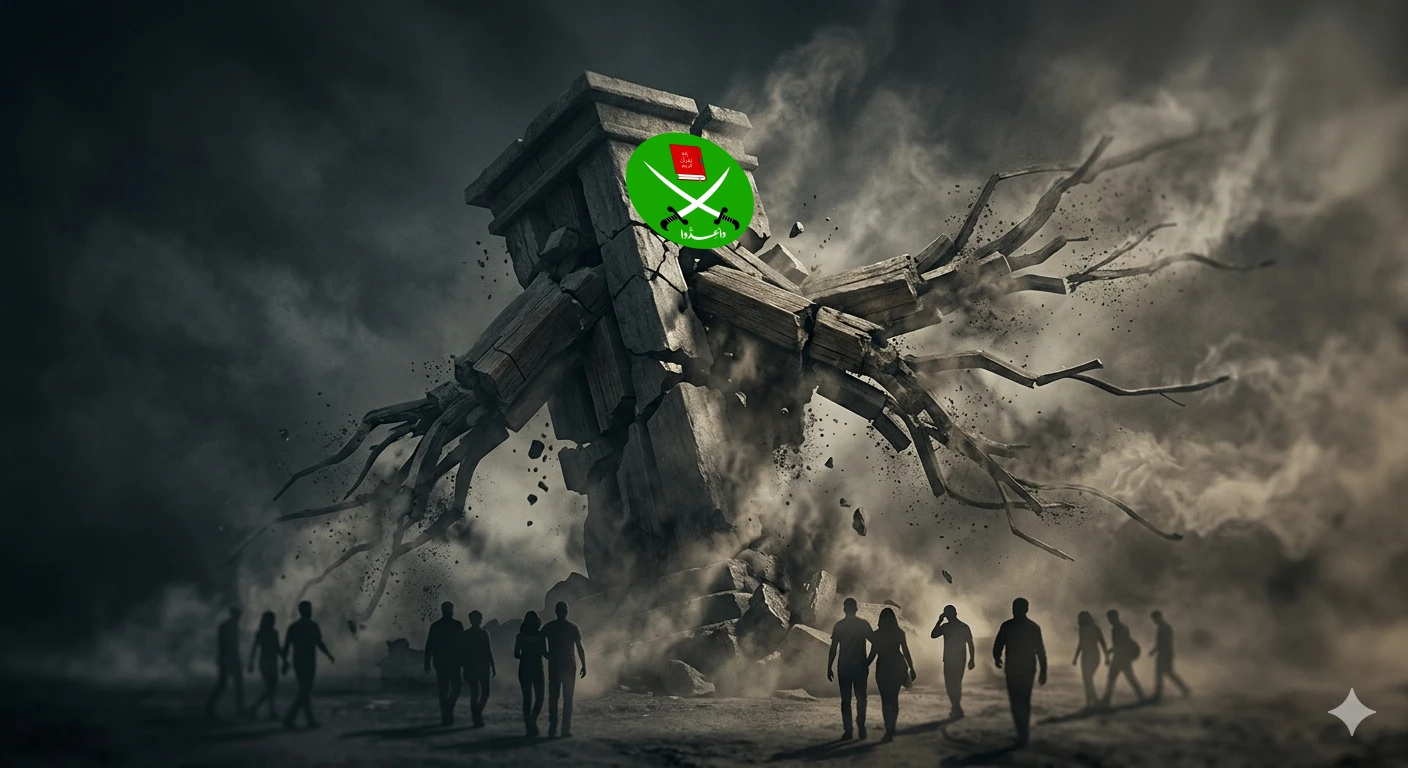
From this standpoint, my reading of Dr. Ibrahim El-Zafaranai's writings is that the group is no longer in the erosion phase, but is currently in the post-collapse phase, especially with the group's division into two components confirming that the group and its original idea failed to resolve the internal conflict that was not visible throughout its history, leaving us with parties that draw their legitimacy from their interpretation of the bylaw that El-Zafaranai described as booby-trapped in his post.
From this point, I will try to explore the group's fate through various scenarios ranging from the issuance of a definitive statement by the imprisoned guide Badi’ that cannot be challenged, to a scenario of establishing a third current leading the group and working to unite it once again. These scenarios are:
- Scenario for Reunification: This scenario may be the ideal solution for the group, but it carries within it another option, which is the declaration of the group's final end if rejected by the conflicting parties. This scenario relies on the capability of guide Mohamed Badi’ to record an audio or video statement - unchallengeable - giving clear decisions regarding the existing division in the group. This may be the only solution that ends the legal problem for all parties, but it is unlikely to resolve the structural problem and the gap between the conflicting parties, as the issue is no longer about "who is the guide," but rather how the group should be managed in general – unless Dr. El-Zafaranai’s brotherhood principle is activated – and if it is activated, the question becomes why was it not activated beforehand?
The guide’s intervention in this case will not solve the bylaw dilemma, as changing it may cast doubt on those who currently adhere to it, while keeping it as is puts the London-based party in doubt. According to El-Zafaranai’s comment, the bylaw is the "shirt of Uthman“ that both parties contested over, causing the group’s division either by its rejection or firm belief in it.
- Scenario of Attrition: This is the most realistic and probable scenario, where both parties continue to drain the group's resources and cadres amid regional and international attacks on the group, ultimately leading to both parties internally draining each other and being externally drained, turning the group into a historical issue rather than an active group.
- Scenario of the Emergence of a Third Current Leading the Group That adopts the vision of the group’s dissidents and members opposed to the current state of the group. It is a weak option, whether internally in the group or externally, as rejoining the group after dissenting is seen as returning to international security restrictions with no substantial benefit, this option would require courage from all parties, both internal who want reform and external who left due to reform issues, but historically, the group does not allow for another current due to its reliance on the culture of obedience and the idea of dissenting against the current leadership is a breach of obedience, as is currently the case where each party declared that the other does not represent the group.
Matters worsen as this third current will face fierce attacks from both parties: Mahmoud Hussein’s front and Ibrahim Mounir’s front, either by casting doubt that the current serves the interest of one party over another, especially since it will strip both parties of their legitimacy, akin to the idea of the reform current that arose within the group, neither party now considers it part of them.
Fate?
The issue is not just about Dr. El-Zafaranai’s post, despite its significance in reviving the group in the seventies, nor is it a view based on some commentators’ comments on the post but rather from a contextual analysis of events and timing.
Based on the above, if there is no radical change in the actual conditions, the group – as a collective and comprehensive entity in its usual form – seems to be choking itself, not by others. The attrition scenario is closest to continuation, and this scenario serves the interests of several parties, making its maintenance a valuable matter that benefits everyone but the group. On a local level, this scenario serves both the old and current Egyptian regime in abolishing the group after a hundred years of its founding, regionally ends the Arab fear of the group's existence, which is seen in most of the Arab surrounding as the most politically and socially organized and most politically threatening to thrones, internationally, as the group is considered by most countries a source of Islamic rebellion and struggle that is no longer desirable.
This is an AI-generated English translation. The original text is in العربية