

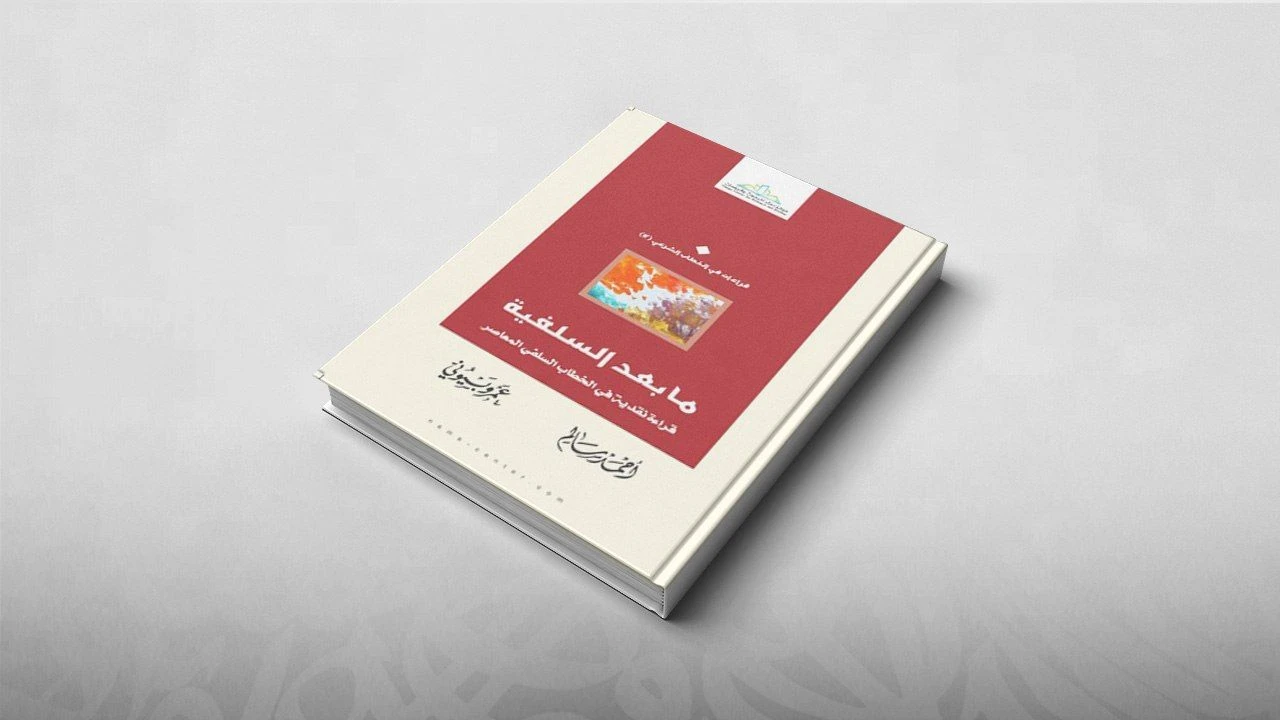
For nearly ten years, I have wanted to read the book "Post-Salafism" by its authors Ahmed Salem and Amr Basyouni – according to the order of the names on the cover – but I refrained from doing so; either because the number of pages is large for me, or because my time did not allow me to read it in one or two sessions as is my habit, for I am one of those who lose passion early.
With this continuous state, I decided to approach the book differently, considering it an analytical intellectual thesis rather than a book that necessarily requires reading its first chapters to understand the results. This method may be disliked by scholars, but I have become accustomed to my own style in writing, reading, and thinking, where I do not adhere to inherited academic or scientific laws, which incidentally caused me a significant problem in my university studies.
And so as not to prolong; I decided to skip the chapters where the author – I'll refer to them with singular pronouns – begins narrating the history of Salafism, its concept, development, and pros and cons; because I am definitely sure I would disagree with what they write, which might affect my later perspective on the results. The primary reason – as I mentioned earlier – is the laziness of reading this large number of pages. Therefore, I started reading from the sixth chapter to the end after browsing the introduction and reading the glossary of terms, where I see the essence of the thesis, its goal, and its core.
My skipping of the first chapters is not merely laziness, but an attempt to protect my mind from the distraction of bias, which would surely occur with this book; as details sometimes are devils that prevent us from seeing the essence, and this is a conclusion I reached after previous experiences that made me realize that knowing what the author wants is more important than wrestling with how they started.
Here are some of my notes on what I've read:
 Temporal context: During my reading of the book, I did not recall its release date, nor did I want to interrupt my flow to search for it, so I deduced upon reaching some points that the book was written at a stage before the recent Saudi changes towards Salafism; it seemed slightly optimistic about Salafism there. Also, his talk about Sheikh Abdul Aziz Al-Tareefi suggested to me that it was written before his arrest, and based on this, I dealt with the text, and this handling will show in the coming lines.
The issue of decline and fragmentation: At the beginning of the sixth chapter, the author talked about the decline of Salafism after the fourth century in favor of theological trends, then its survival from this decline in the time of Ibn Taymiyyah, and later during the Najdi Wahhabi movement. However, in the same chapter, he considered that one of the main reasons for the decline is internal fragmentation (the ailment of division), while he cited on the same page that Salafism in the time of Imam Ahmad used to pride itself on the consistency of its scholars' opinions. Here I thought: How did Salafism decline after Imam Ahmad's time if it was not internally fragmented? Reading the first chapters might change this view of mine, yet I see that citing "consistency" was not useful here in establishing the issue of fragmentation, which we do not deny.
Symbolic poverty: The author then moved to the issue of "symbol" in the section "symbolic poverty". In my opinion, this section is the most important in this chapter – as the material, social, and governmental support in the Salafi movement was linked to the existence of the symbol, which the author made clear, and it is the most beautiful and clear; because the fragmentation occurring is due to the absence of symbols, whether through their death or their weakened presence due to surrounding factors. Hence, I saw that the absence of the symbol is the "origin" from which the rest of the reasons sprouted, and even when I returned to the index, I found that I wouldn't have changed the order of this section.
Symbol omission: When reading what the author wrote about Sheikh Abdul Aziz Al-Tareefi, my mind involuntarily began to link to the issue of "intentional omission" of symbols that occurred over the last ten years; in my humble opinion, I think that as soon as someone possesses some of the elements of influence that might make them a symbol, they are quickly omitted by someone with attempts to eliminate their widespread legacy and limit it – I even thought that some state apparatuses might keep this book in their drawers as a reference.
Financial support: In the chapter entitled "Support Channels and Flow Barriers," I see that the author succeeded in explaining this issue, which in itself requires a separate book, especially at this timing. More than 10 years after this thesis, it seems to me that some Salafi groups have become aware of this lesson, and have already started establishing huge economic systems to solve the financial flow crisis, which is clear and evident in the Alexandrian Salafi school.
The concept of the bridge: In the chapter "Post-Salafism," I see that the details mentioned have been strengthened and endorsed by time. I liked the author's saying: "It can be said that the historical bridge over which the Enlightenment stream crossed from Muhammad Abduh and Rashid Rida to now are the Muslim Brotherhood," as well as the reference to Rashid Rida being the bridge for those transitioning from the Wahhabi trend to the reformist. My admiration for this link came because when I think about "Salafism layers," I find that what occupies me most when thinking about this issue is the "link" between those layers, which the author called the "bridge"; where there are layers that can literally be described as a link through which one moves from one trend to another without belonging to either and without clashing with them.
Future projections: Despite only a decade having passed since the book's publication, the extent to which the author's vision has been realized is significant. There is a page in the book, in my opinion, if nothing else was written, it would suffice, which talks about "the fortune of society" and predicting the rise of the "political debauchery" stream.
The author: This thesis can be considered the doctoral thesis of the author, and the influential factor in their transformation, whether in the outward form or as appears through his subsequent writings, into a Salafi state "Post-Salafism". It can be said that the author strongly believed in his thesis, which I incidentally do not completely disagree with in the results he reached, and the reasons that led and will lead to the decline of Salafism.
The concluding paradox: As evidence that the author's foresight was ahead of its time, an example of one of the most famous critics of the book when it was released came to mind, as I then followed his articles and media appearances, he is a personal friend of the author Ahmed Salem; I returned and searched for him now, and found that he perfectly embodied the vision of "Post-Salafism," so he became effectively "Post-Salafi" after being one of the famous critics of the thesis.
A technical and psychological issue: What bothered me most during reading the book was the matter of adding the dagger alif to the ya to distinguish it from the real ya, and its addition caused, in my opinion, visual annoyance, as the eye is used to numbers indicating notes or references when reading books, and the dagger alif is similar to the Indian numeral one, which caused me great distraction when reading the pages as I would involuntarily scroll down to look for the footnote at every dagger alif.
Note: This is a selective reading that does not replace reading the book or thesis, and I think I missed a lot and perhaps it even affected my observations – maybe I'll return to read the book again at another time.
The title – the post title – does not refer to the post-modern intended in the book but is a hook to attract the reader.
This is an AI-generated English translation. The original text is in العربية